



The workshop
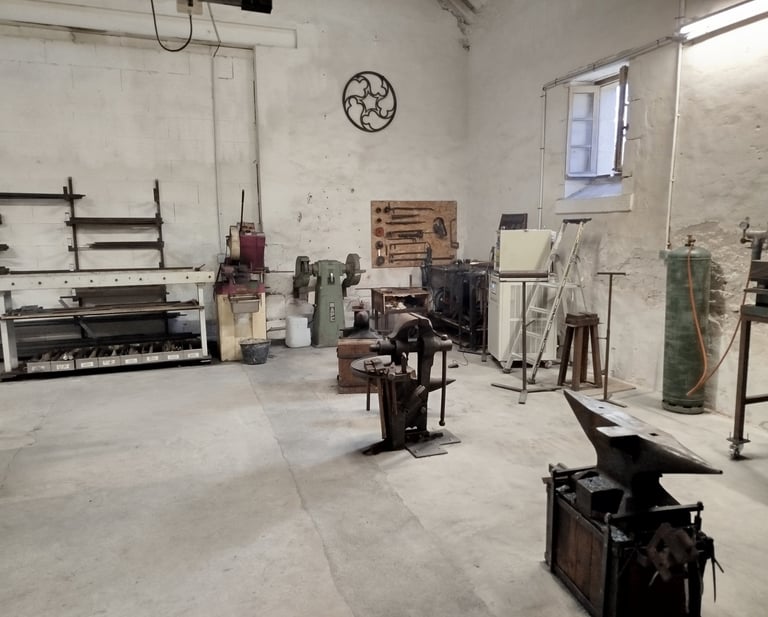
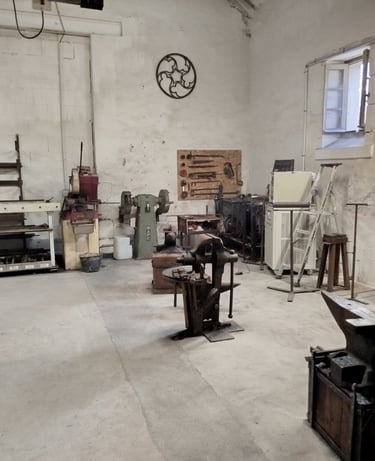
My workshop
Located in Ligugé, just south of Poitiers, my workshop is situated in a unique setting. The former Ligugé spinning mill now houses a shared workspace known as a "third place."
This hub brings together a wide variety of entities, including a FabLab, a mobile toy library, stonemasons, a woodturner, and even brewers.
We pool resources as much as possible—sharing machinery, marketing efforts, and events like the European Artistic Crafts Days, as well as our expertise.
It is thanks to these people that I have been able to grow—both in terms of the complexities of my craft and on a personal level
I would like to thank them for that.
The study
Before forging a tool, one must understand its requirements:
Which steel to choose? What geometry? Which heat treatments to apply?
All of this involves a process of in-depth research, prototyping, and careful consideration prior to commercialization.
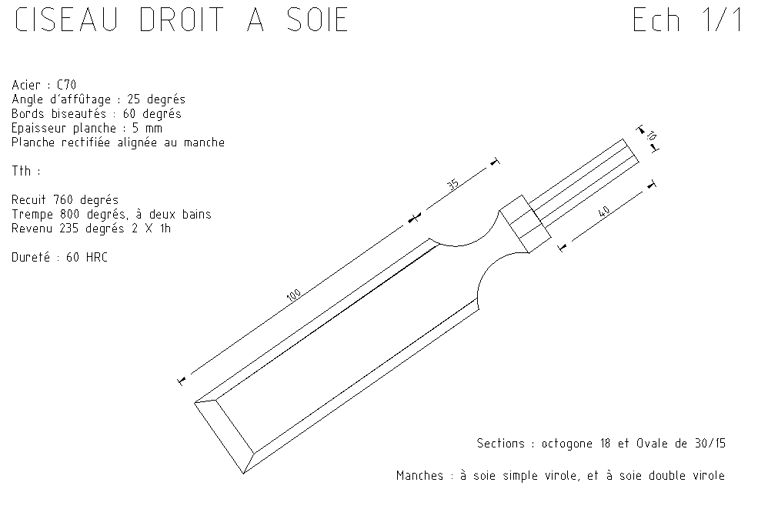
This step involves heating a piece of steel to shape it through processes such as deformation, forging, bending, upsetting, die-forming, or forge welding, transforming it into a tool.
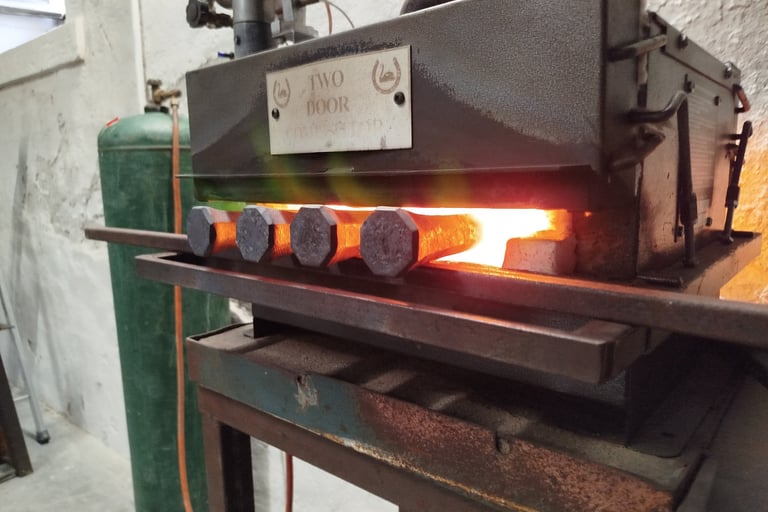
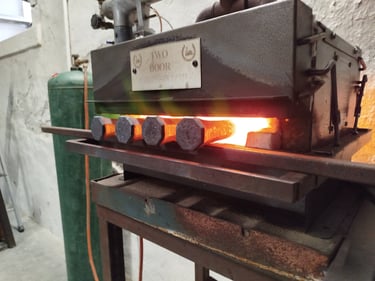
I use two forging methods: gas and induction. No more coal.
Forging :
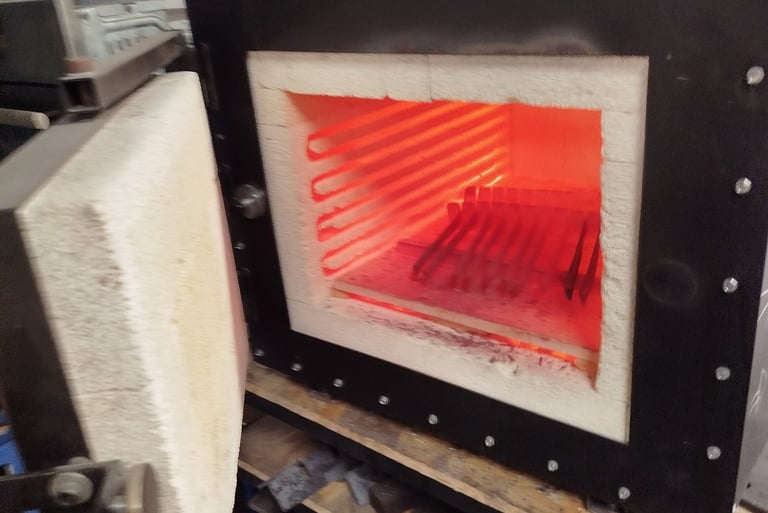
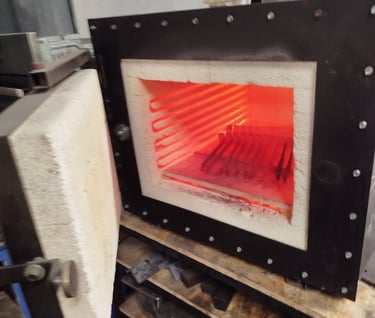
I perform heat treatments, such as hardening and annealing, exclusively using an electric furnace with temperature control accurate to within 2 degrees.
This allows me to achieve precision in the hardness-to-toughness ratio from one product to another. Each tool is tested accordingly. I have learned a great deal about metallurgy since I began working in this field.
Heat treatments
Grinding
I have several precision machining machines at my disposal :
3 belt grinders
1 surface grinder
3 bench grinders
an abrasive cut-off saw.
This set of machines enables me to machine the various tools I manufacture with great precision.
Using an XY-axis table mounted on a belt grinder, I true up the flatness, parallelism, and squareness of the tools I manufacture.
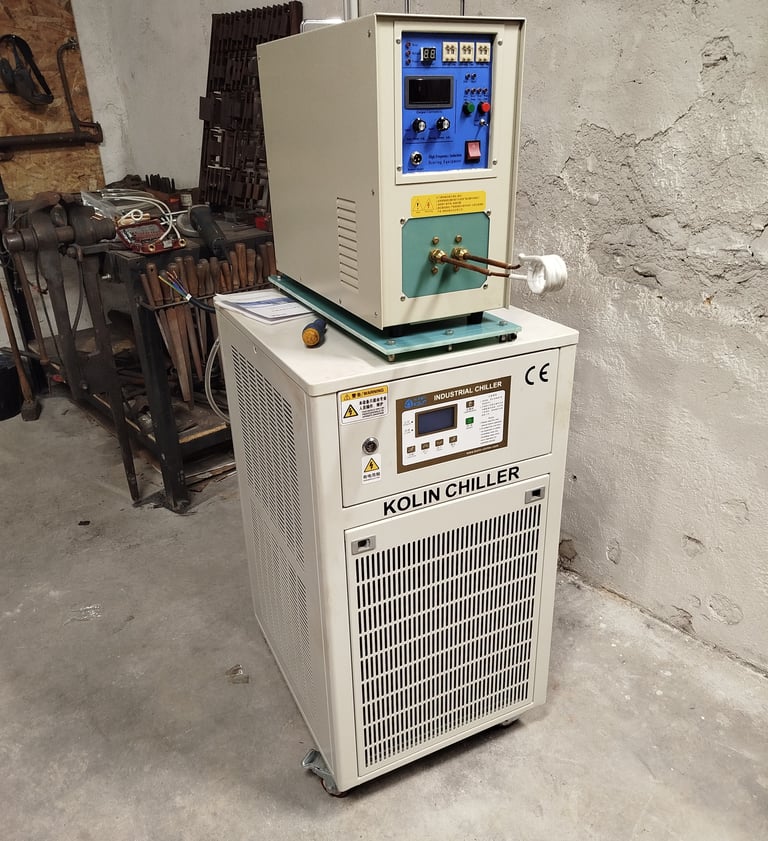
J'ai récemment abandonné le forgeage au charbon. Voici le remplaçant, en complément du gaz : la forge à induction.
Pourquoi ce choix ?
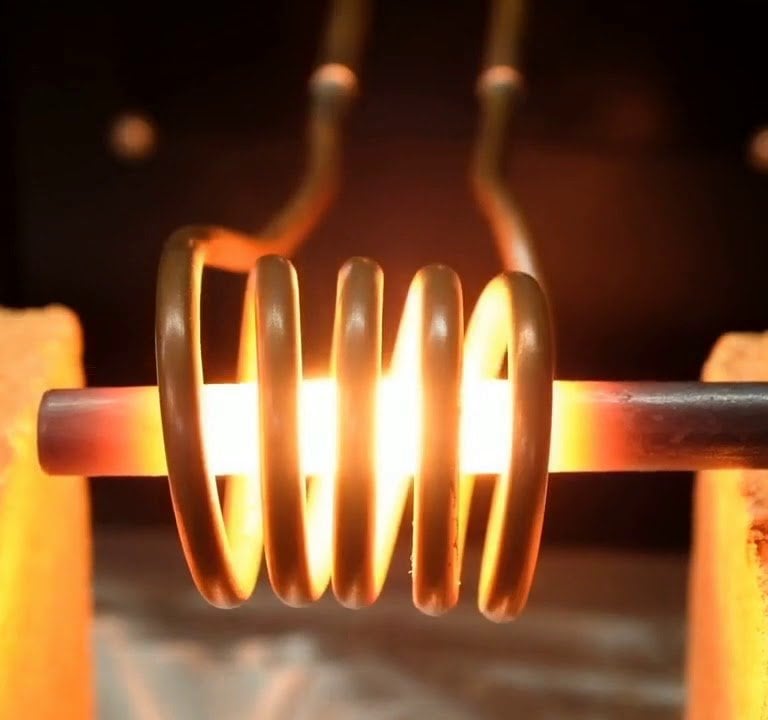
I recently gave up coal forging. Here is the replacement—complementing my gas forge: the induction forge. Why this choice?
1) My health: coal forging is very harmful, even with proper ventilation.
2) Impact on neighbors: coal has a strong odor; some people like it, others don't.
3) The environment: Today, the energy supply in France is predominantly low-carbon.
4) Convenience: induction offers controllable, instant energy. While a coal forge requires lighting, heating up, and constant tending, an induction forge needs far less preparation and maintenance.
5) Control: In a coal forge, the iron is buried beneath the fuel, making it harder to gauge the metal's temperature at any given moment. With an induction forge, you have a direct view of the workpiece and optimal temperature control.
6) Handling: coal requires storage—often forty 25kg bags—taking up valuable workshop space.
7) Space: A coal forge is stationary and takes up a significant amount of room; it also requires a chimney and a hood. An induction forge is much more compact and can be mounted on casters.
8) Dirt: the dust from a coal forge can make a workshop dirty quite quickly.
9) Absence of oxidation: A coal forge heats via combustion. It relies on the "fire triangle": oxidizer, fuel, and heat source. Here, the oxidizer is oxygen. Oxygen... oxidizes the steel; it causes rust. This results in a loss of material—known as "fire loss"—ranging from 10% to 20%. With an induction forge, there is no combustion and minimal oxygen, making it highly useful for forge welding!
10) Comfort: Summers are getting hotter. A coal forge radiates heat, making the working environment very unpleasant. 1
1) Handling workpieces: Parts heated by induction can be very short and held by hand, as heat conduction is minimal.
12) Localized heating: In upsetting operations, for example, you need to heat a specific area of the workpiece while avoiding unwanted heating via conduction; this is much easier to achieve with induction.
13) Fuel cost: Coal has become very expensive. I recall buying it for 19 euros per 25 kg bag about ten years ago. Today, it costs nearly 40 euros per bag. In terms of electricity consumption, induction costs me roughly four to five times less.
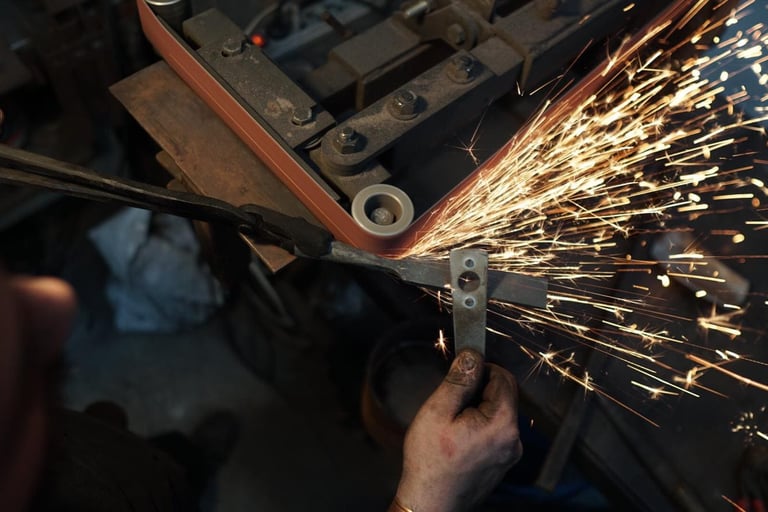
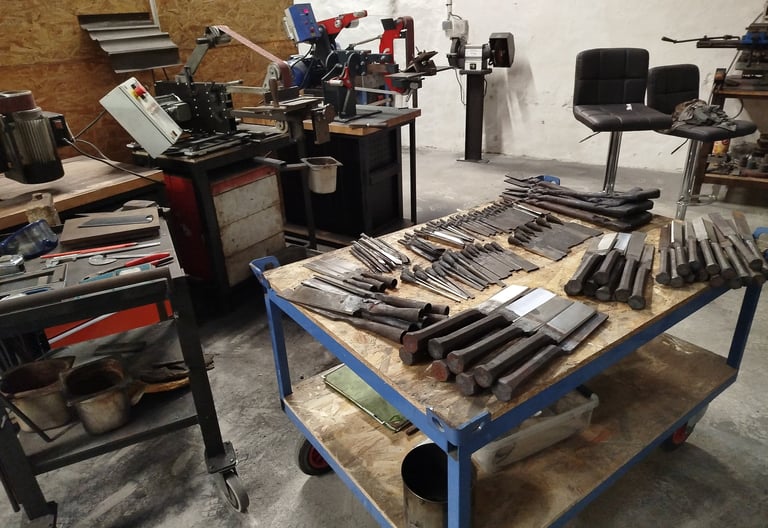
After the final finishing touches, this is where I come to fit the tool to its handle. I had to modify and adapt the workspace to suit my workflow, whether the assembly involves a socket or a tang.
Then, finally, comes the sharpening. I have injured myself all too often by sharpening before attaching the handle.
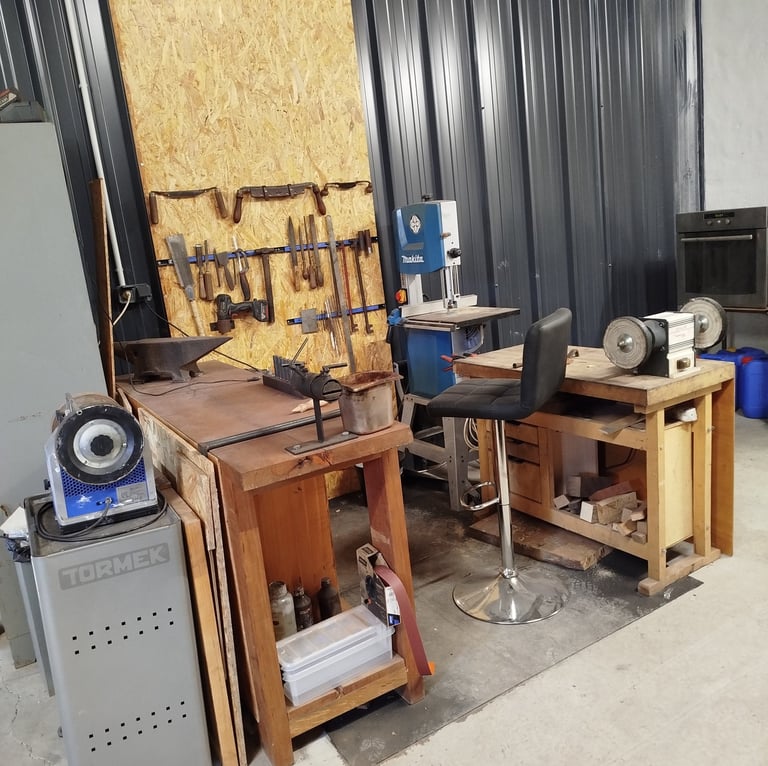
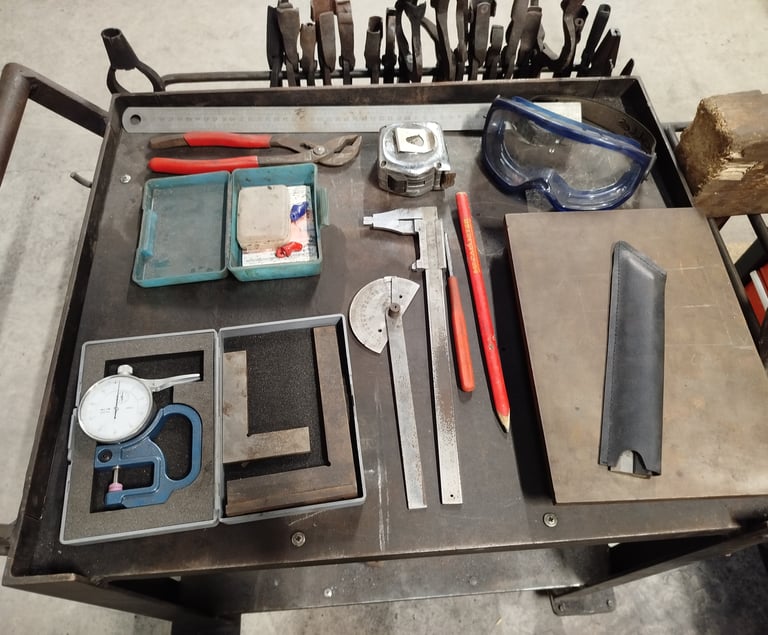
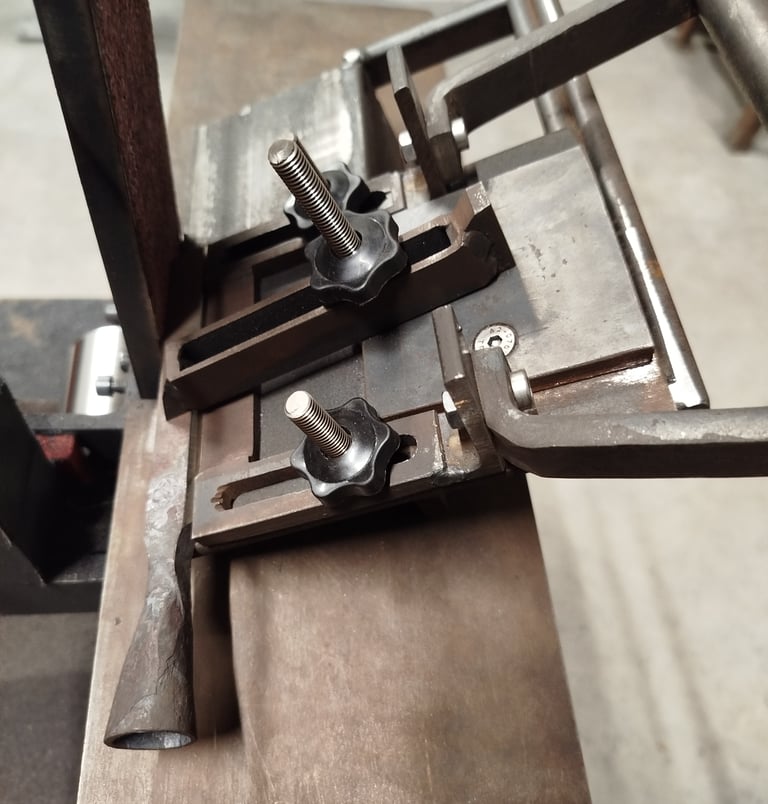
It is not uncommon for me to have to make a new jig for a particular operation. Here, a machining jig for the side bevels of wood chisels.
The tool came into being following the design of its leather case; it is now ready to tackle the many projects it will help you create.
Fell free to visit my shop, or my catalog.
You want to visit the wokshop ? contact me and take a rendez-vous !
Mentions légales et conditions générales de vente
site réalisé par Digipixals